

 Contact us
 Visit CPRE.org
 Donate
Shine on, harvest moon

On the evening of 26th September, look east and you may see one of nature’s most beautiful autumn spectacles: the Harvest Moon.
As the sun slips below the horizon and the last light fades from Norfolk’s big skies, a glowing full moon will begin its journey above the eastern horizon.
There is something particularly fitting about seeing the Harvest Moon over Norfolk. This is a county shaped by farming, where the rhythms of the agricultural year have long been written into the landscape and into the night sky.
A month really is a ‘moon’ word
The Old English word mōnaþ was related to the word for moon, and originally referred to the interval between one new moon and the next. In other words, a “month” was quite literally a moon cycle.
A lunar cycle, from one new moon to the next, takes about 29½ days. Twelve such cycles add up to around 354 days, which is why lunar calendars and our modern 365-day solar calendar don’t quite fit together.
Over the years, a collection of traditional names for the full moons became popular. You may have heard of these:
- January – Wolf Moon
- February – Snow / Ice Moon
- March – Worm / Storm Moon
- April – Pink / Growing Moon
- May – Flower / Hare Moon
- June – Strawberry / Mead Moon
- July – Buck / Hay Moon
- August – Sturgeon / Corn Moon
- September – Harvest Moon
- October – Hunter’s Moon
- November – Beaver / Snow Moon
- December – Cold / Winter Moon
The names reflect seasonal events, wildlife and traditional observations of the natural world. However, they aren’t universal: different cultures have developed their own names and traditions for the Moon.
So what makes the Harvest Moon special?
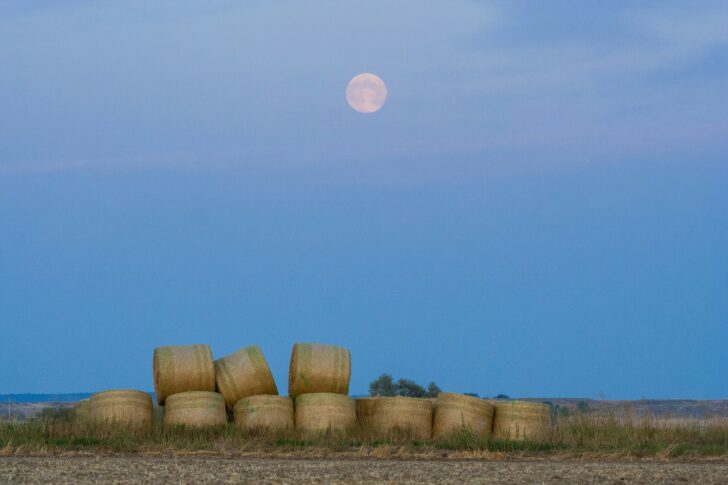
Unlike most full moons, the Harvest Moon isn’t fixed to a particular month.
It is the full moon closest to the autumn equinox.
In 2026, the equinox falls on 22nd September, making the full moon on Saturday 26th September this year’s Harvest Moon. It reaches full phase at around 5.49pm UK time, although you’ll need to wait until moonrise to see it above the horizon.
Its name has an agricultural connection that makes perfect sense in a county like Norfolk.
Around the time of the autumn equinox, the Moon traditionally rises relatively soon after sunset on several consecutive evenings. This meant that farmers had extra natural light after sunset, giving them more time to bring in crops during the busy harvest period.
Before tractors, combine harvesters and electric lighting transformed farming, that extra moonlight was genuinely useful. The Harvest Moon therefore became part of the agricultural calendar – a celestial reminder that the harvest needed to be gathered in.
And Norfolk’s landscape still carries the imprint of that agricultural heritage. Our wide fields, ancient lanes, farms, hedgerows and open horizons make the county an extraordinary place to experience the changing seasons.
And what about the Hunter’s Moon?
The next full moon, in October, is traditionally known as the Hunter’s Moon.
Its name also has a practical connection to the changing agricultural year. Once the harvest had been gathered, fields were more open and animals easier to spot, while the bright autumn Moon provided useful light for hunting.
Like the Harvest Moon, the Hunter’s Moon can create a spectacular display when it rises low in the sky.
Why does the Moon turn orange or red?
This is where things get particularly magical – but the explanation is pure science.
The Moon itself isn’t suddenly changing colour.
When it is close to the horizon, its light has to travel through much more of Earth’s atmosphere before reaching our eyes. The atmosphere scatters shorter blue wavelengths of light more readily, leaving proportionally more of the longer red and orange wavelengths reaching us.
The result can be a Moon that appears deep golden, orange or reddish as it rises. Dust and pollution in the atmosphere can intensify the effect.
And although photographs sometimes make the Moon appear enormous, that’s another optical trick. The famous “Moon illusion” makes the Moon seem larger when it is close to the horizon, particularly when we see it alongside familiar features such as trees, buildings or the landscape.
Why Norfolk is made for moon watching
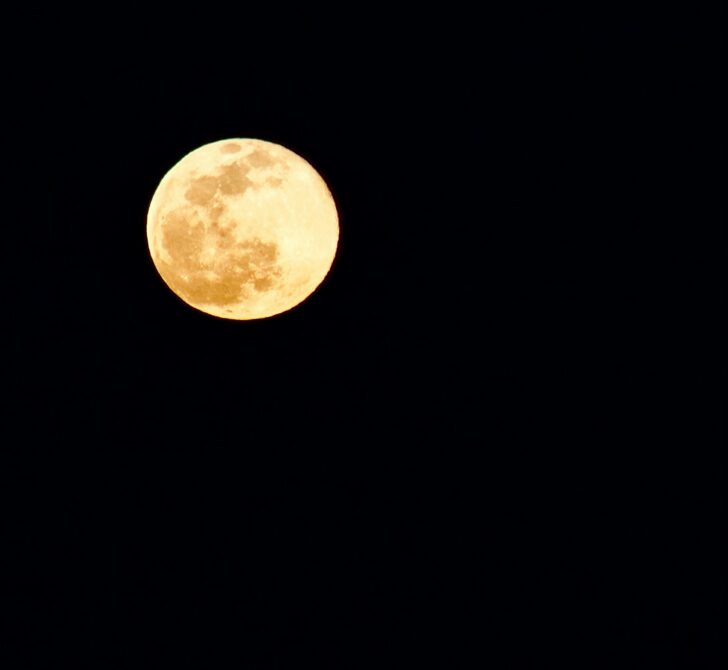
There are few better places to appreciate a Harvest Moon than a county with wide horizons, open farmland and relatively low levels of urban development.
Norfolk’s big skies are part of what makes the county distinctive. Step away from the glow of towns and cities and the landscape changes as darkness falls. Fields become silhouettes, church towers stand out against the horizon and the stars begin to emerge.
A reminder of what we could lose
But beautiful night skies aren’t guaranteed.
Norfolk’s darkness is part of its rural character, yet light pollution is increasing. Artificial light can obscure the stars, alter the natural behaviour of wildlife and gradually change the character of rural landscapes.
CPRE Norfolk’s research has shown that fewer areas of Norfolk can now be considered truly dark, while increasing development and unnecessary security lighting continue to put pressure on our night skies.
That matters because darkness is not simply the absence of light. It is part of the landscape.
Norfolk is fortunate to be one of the UK’s best places for experiencing the night sky, with some residents among the small proportion of people in Britain who can still see the Milky Way clearly. Protecting that darkness means protecting something increasingly rare.
CPRE Norfolk campaigns to protect our dark skies and dark landscapes, working with councils, planners, businesses and communities to reduce unnecessary and intrusive lighting.
You can find out more about why Norfolk’s darkness matters – and what you can do to help protect it – on our Dark Skies and Dark Landscapes page.
So this September, look up.
Find a quiet spot. Turn off the torch. Let your eyes adjust.
And as the Harvest Moon rises over Norfolk’s fields, take a moment to think about the generations of farmers who have watched the same Moon crossing the same skies – and about the countryside and night skies we have a responsibility to pass on.
Sometimes discovering Norfolk means simply stopping, looking up and remembering how extraordinary the view really is.